
Disability & Kink (Part 1): How Ableism Decides Who Gets to Play
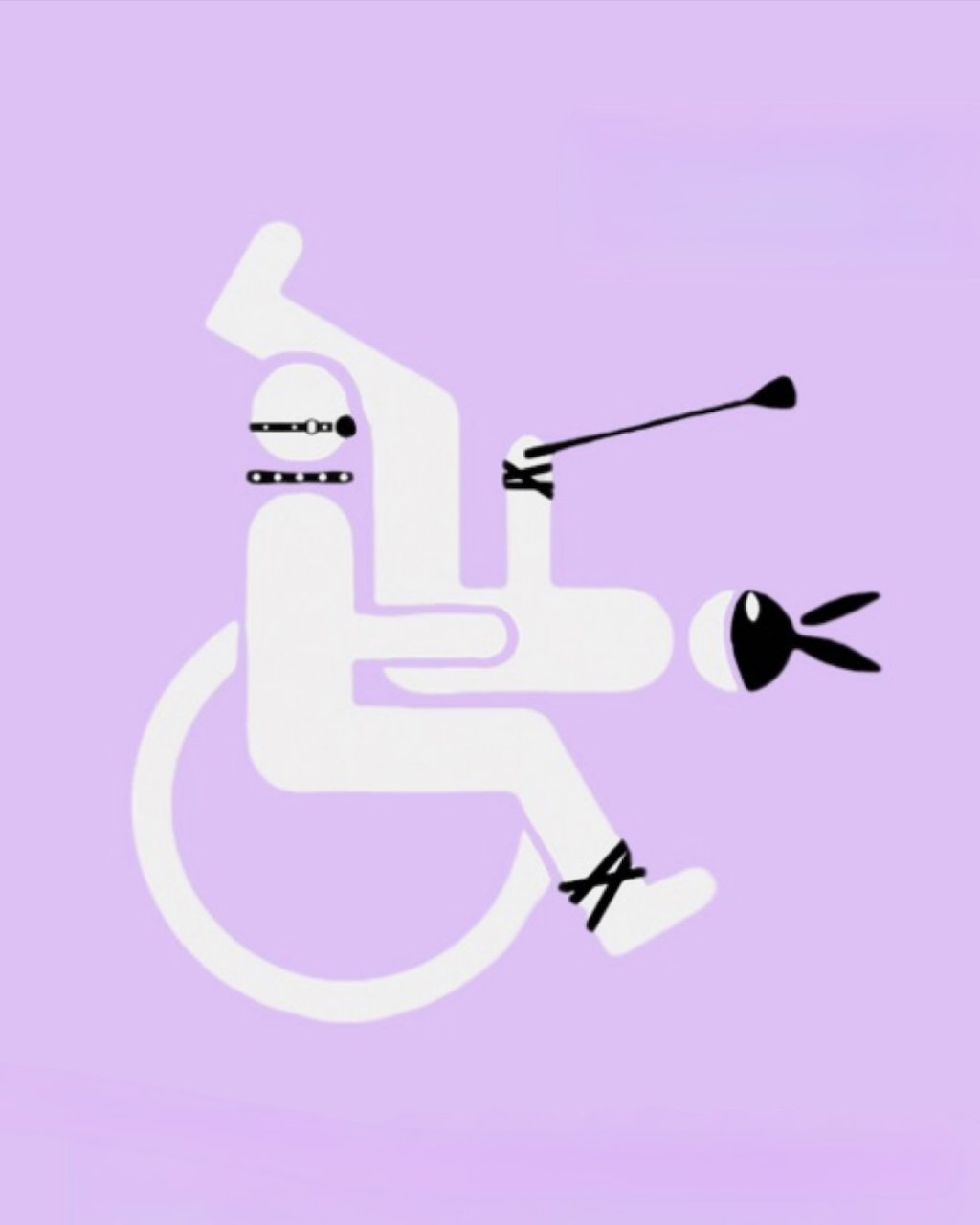
Ableism is one of those forces that often goes unnamed, especially in conversations about kink.
And still, it’s always at play, quietly influencing who feels welcome, who feels desirable, and whose needs are prioritized.
But before we can talk about things like access, inclusion, or meaningful change, we need a shared language for what’s happening beneath the surface. So that’s where we’re starting.
This is part-one of a three-part blog series on disability and kink, first taking an honest look at how ableism shows up in our assumptions, our spaces, and our kink cultures.
A little bit of background…
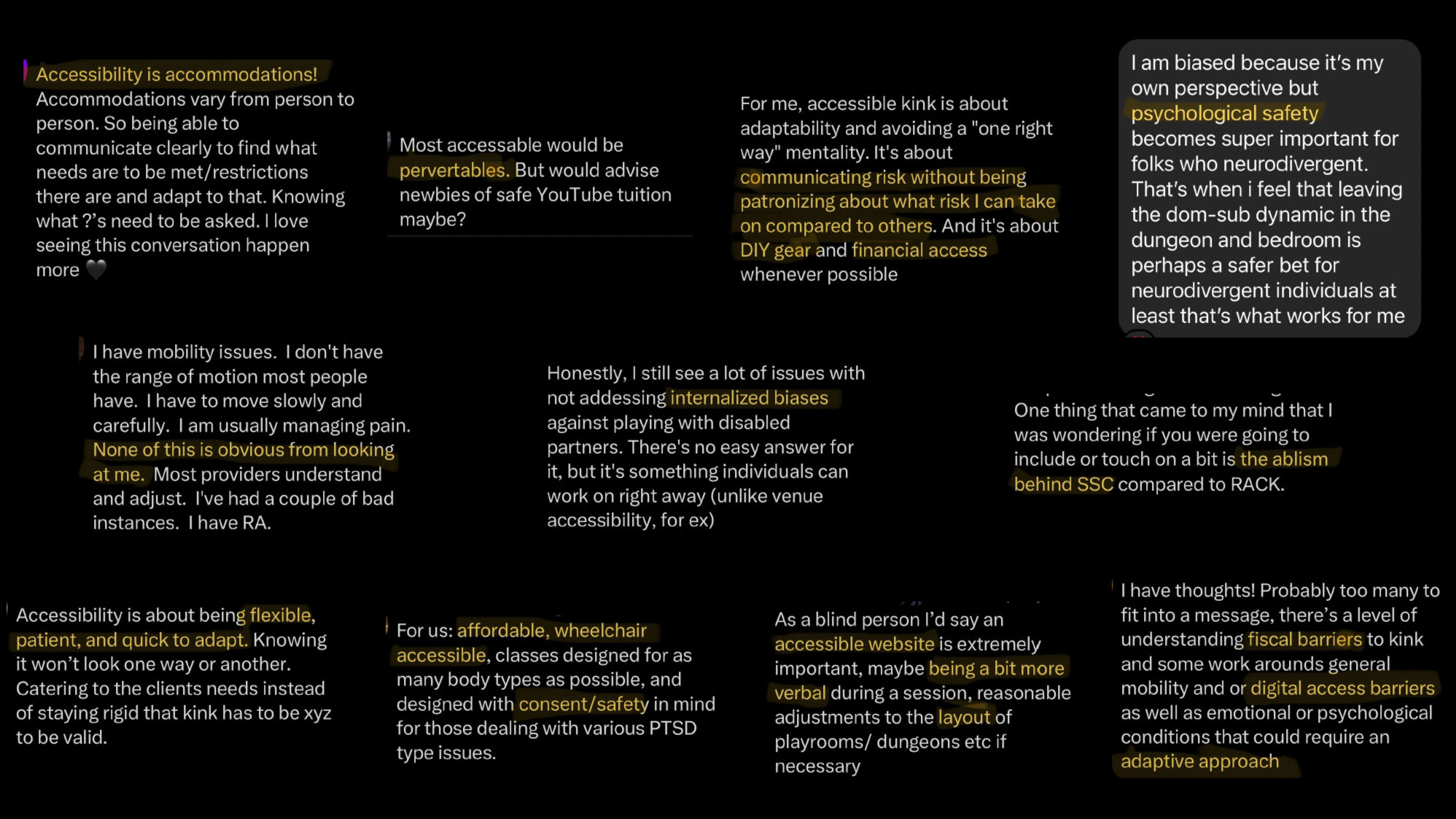
Some time ago, I posed a question on Twitter: What does accessible kink mean to you?
The replies I got often touched on similar themes, and I found that 3 main categories emerged: ableism, access, and accommodations.
Some of the responses are featured below, but I’ve also summarized the key topics that fall under each category in point form underneath.
Ableism:
Language
Biases
Misinformation
Social Norms
Access:
Fiscal
Digital
Physical
Psychological
Accommodations:
Adaptability
Intentionality
Creativity
Safety
Each of these 3 categories spell out the real-life obstacles disabled folks deal with in kink.
These are things that can make participation tough, but they also show us how much potential there is to make kink spaces more welcoming and genuinely accessible.
I want to break down each of these areas and share thoughts on how we can do better, but before I can delve into the categories of access and accommodations (check out parts two and three), I think that it’s crucial to understand the nuances of the first category: ableism. Specifically, how ableism shapes not only our expectations, but also the communities and dynamics we're part of, especially when it comes to kink and sexuality.
So, what is ableism anyway?
Let’s break it down. At its core, ableism is all about the assumptions and systems that divide people into two categories: “normal”, and not.
Certain bodies and minds are seen as the default (aka “normal”) while others are positioned as inconvenient, less capable, or needing to be fixed (aka “not normal”).
Ableism shows up in everyday ways, like what we expect people to do without help, how we judge worth or competence, who we see as desirable or attractive, and whose needs are treated as a burden.
It can be obvious, like when a venue has stairs but no ramp or elevator, but ableism is often much sneakier than that. Ableism usually isn’t loud or in your face, it’s subtle, internalized, and learned over time, informing the ideas we carry about ourselves and others.
When it comes to sexuality, ableism quietly shapes how we’re taught to desire, touch, and be touched. It decides which bodies are sexy, capable, or worthy of pleasure, and which ones get overlooked, pitied, and desexualized all together. Ultimately, ableism influences everything from consent scripts and relationship dynamics to intimacy and the ways we understand “normal” sexuality.
The point I’m trying to preface here is that disabled people are rarely considered in kinky spaces because disabled people are rarely considered sexual beings. Our culture still treats disability and sexuality as mutually exclusive. Either disabled people are desexualized, infantilized, or framed as inherently undesirable, or they are fetishized in ways that strip them of agency and humanity. In both cases, disabled people are denied things like complexity, autonomy, and desire.
When kink communities unconsciously absorb these beliefs, disabled bodies and experiences are left out of conversations about pleasure, consent, access, and play. When disabled people aren’t imagined as people who want sex, explore power exchange, or seek erotic connection, their needs are never built in from the start.
This absence isn’t accidental. It’s the result of ableism shaping who we think kink is for, and whose desires are taken seriously enough to matter.
Ableist assumptions in kink
Ableist assumptions are the beliefs and expectations we hold (often unconsciously) about bodies, minds, and capacity. They are the stories we tell ourselves about what/who is “normal”, safe, desirable, or competent.
Ableism shows up in our assumptions about pain tolerance, endurance, communication, and control, often positioning disabled bodies as fragile, unsafe, or incompatible with power exchange.
These ideas can restrict who is seen as a “real” Dominant or “real” submissive, whose desires are legitimized, and what kinds of changes are worth making so that everyone can join in.
Examples of ableist assumptions:
Disabled people can only be submissive (or shouldn’t participate at all) because they’re fragile or weak.
Someone can’t be a top or Dom/me because they’re disabled, chronically ill, or have limited mobility or stamina.
Disabled people are unsafe to play with because they are incapable of consent, lack agency, or cannot advocate for themselves.
Disabled kinksters are always on the receiving end of care, rather than capable of giving care.
Access needs mean someone is high-maintenance, risky, or not worth the effort to play with.
Consent must look simpler, slower, or less erotic when disability is involved, rather than intentional and charged.
Disabled people are only interested in soft, gentle, or non-sexual play (not things like sadism, humiliation, or edge play).
Ableist barriers in kink
Ableist barriers are what our assumptions create in practice. They are the physical, social and cultural obstacles that prevent disabled people from fully participating.
The key difference is that assumptions live in mindset, while barriers live in systems and structures. But they reinforce each other: ableist assumptions justify ableist barriers, and barriers then make those assumptions seem “natural” or inevitable.
Ableist barriers in kink often operate with subtlety, embedded in our unspoken expectations about how bodies are “supposed” to function in scenes and spaces. When someone’s body or nervous system doesn’t meet these expectations, the problem is framed as the person, not the structure of the scene, the space, or the culture surrounding it.
Challenging ableism in kink requires both unlearning the beliefs that limit imagination, and dismantling the structures that perpetuate exclusion.
Examples of ableist barriers:
Rigid protocol requirements (kneeling, standing, holding positions, eye contact, silence) without alternatives or flexibility.
Time-based expectations that assume people can play for long, uninterrupted stretches without breaks.
One-size-fits-all safewords that don’t account for nonverbal players, different communication styles, dissociation, or sensory overload.
Venue layouts that require stairs, narrow pathways/doorways, or inaccessible furniture with no alternatives.
Not hiring professional Dominants/submissives/service providers who identify as disabled due to assumptions that they cannot provide you with a “real” kink experience.
Gatekeeping education and mentorship, where disabled kinksters are seen as too risky or not capable to teach or train.
Lack of private or quiet areas for regulation, aftercare, medication, or decompression.
Treating aftercare needs that differ from the norm as inconvenient, indulgent, or overly demanding.
Judging fluctuating capacity as inconsistency, unreliability, or poor character rather than a normal aspect of disability (and of just being a human in general).
Treating access needs like medication timing, mobility aids, and sensory accommodations as disruptions rather than part of normal negotiation.
Ableist language in kink
Ableism isn’t only reflected in our internal beliefs and subsequent actions. It’s woven into the very fabric of kink communities, right down to the words we use.
Take the “Safe, Sane, Consensual” (SSC) model. If you’ve spent any time in kink spaces, you’ve probably heard this phrase tossed around a lot. Now don’t get me wrong, the intention behind SCC is objectively good. But when you stop and think about it, the word “sane” has some seriously ableist undertones.
‘Sanism’ is the systemic discrimination or oppression of individuals who are perceived to have mental health disorders or cognitive impairments. It’s entirely built on stereotypes and misconceptions about neurodiversity and mental health.
By connecting ‘sanity’ and ‘safety’, we're suggesting that only those deemed ‘sane’ are capable of engaging safely in kink. This perspective marginalizes folks with mental health conditions or people who are neurodivergent, and may exclude them from full participation in kink spaces.
Try these instead:
RACK: Risk-Aware, Consensual Kink
PRICK: Personal Responsibility, Informed, Consensual Kink
CCC: Committed, Compassionate, Consensual
FRIES: Freely given, Reversible, Informed, Enthusiastic, and Specific
Another example is the term “gimp”: an ableist slur rooted in mocking physical disability, historically used to demean people with mobility impairments. Although it’s been adopted in kink contexts to describe a type of outfit, a particular role, and/or a submissive archetype, its origins are actually tied to the dehumanization and humiliation of disabled bodies.
When the term is treated as neutral or playful without consent or context, it reinforces harmful ideas about disability and degradation.
Admittedly, I too use this term in specific contexts, but examining language like this invites us kinksters to be more intentional, separating consensual roleplay from actual oppression, and choosing words that don’t rely on ableist harm to purposefully and/or playfully dehumanize someone.
Final note: This isn’t about perfection or getting it “right” all the time. Ableism is deeply ingrained, and most of us (including me, a disabled person) are still unlearning it.
The goal here isn’t to shame individuals, but to widen our imagination of what kink can be when we stop designing it around a single idea of whose bodies and minds belong. When we challenge ableist assumptions, dismantle ableist barriers, and become more intentional with our language, we make kink more ethical, creative, and accessible.
Check out part-two, where I offer a practical guide to accessible kink scenes with concrete ways to actually make our play more inclusive.